2026 CRNA Locum Demand Update
Prepared September 2026 from the published figures linked below. This post reports published industry numbers; it is not career or financial advice.
Something is shifting in where CRNAs work, and the 2026 numbers make it hard to ignore. What follows isn’t my opinion — just the figures as published, so you can factor them into your own decision.
More CRNAs are going independent
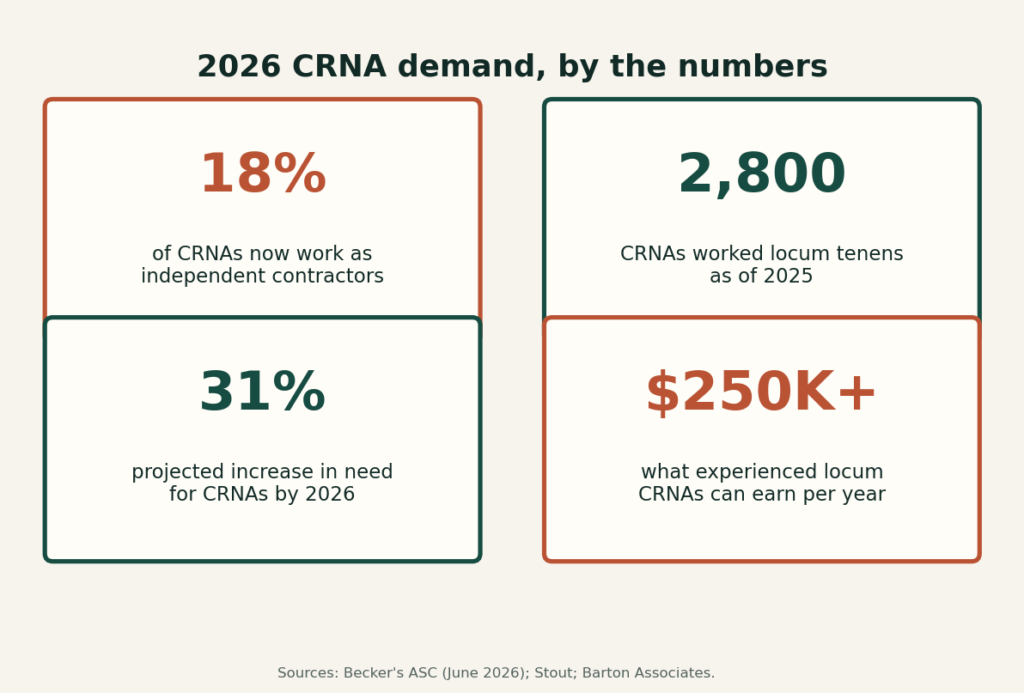
Becker’s reported in June 2026 (“CRNAs are leaving hospital jobs — where are they going?”) that out of roughly 57,000 actively practicing CRNAs in the United States, about 18% now work as independent contractors rather than traditional employees — a share Becker’s describes as growing. As of 2025, around 2,800 CRNAs had worked locum tenens, either alongside a permanent role or as a standalone career, per a report from advisory firm Stout.
The pay side of the story
The same Stout report, via Becker’s: experienced CRNAs doing locum work can earn $250,000 or more per year, with annualized pay exceeding $300,000 in premium-pay markets. For urgent assignments, some hospitals are offering $275 to $325 per hour, or higher. Becker’s calls locum and contract work “the fastest-growing destination” for CRNAs, and notes shortages concentrated in rural markets, independent-practice states, and ASC-heavy regions.
CRNA pay is growing twice as fast as anesthesiologist pay
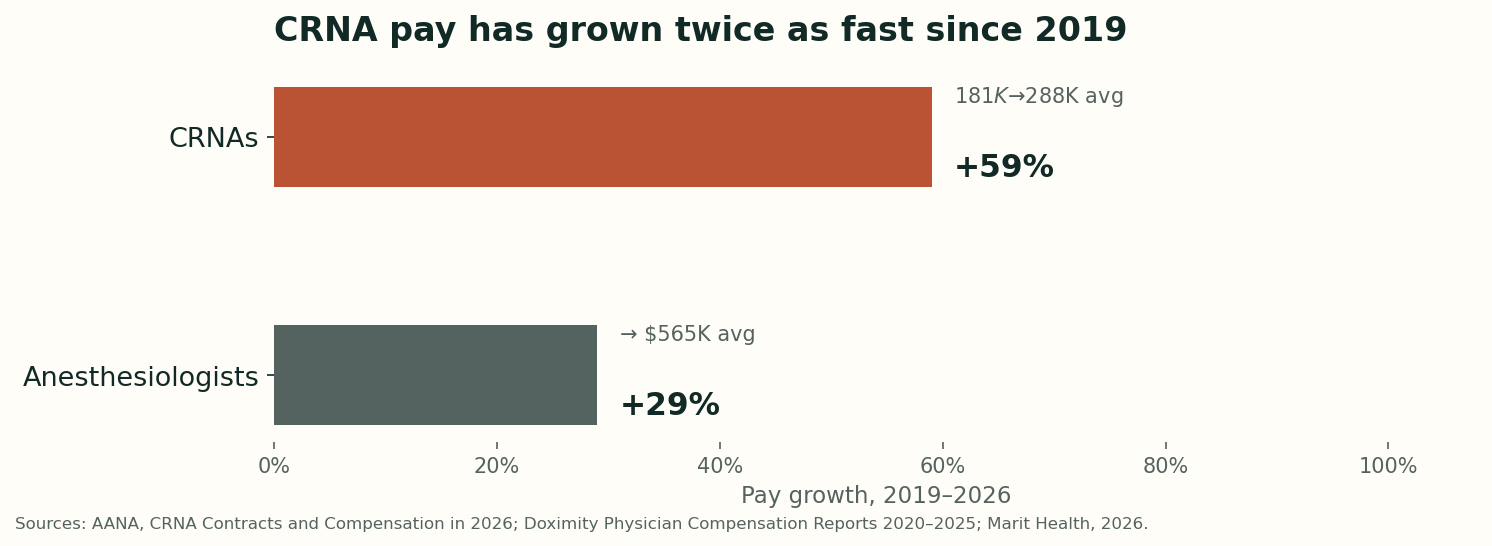
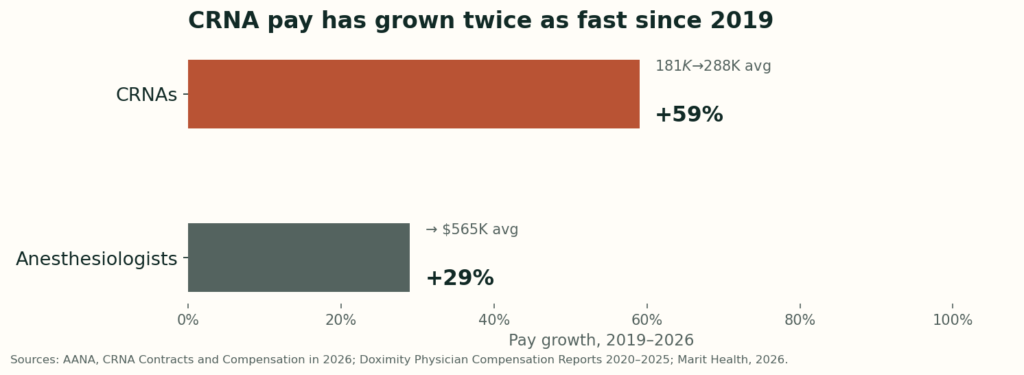
Here’s a number worth sitting with: since 2019, average CRNA pay is up 59% — from about $181K to $288K — while physician anesthesiologist pay grew 29% over the same period. That gap in growth rates comes from Marit Health’s 2026 compensation data (built on AANA’s CRNA compensation survey and Doximity’s physician reports).
Marit names the driver: locum tenens. CRNAs are earning $190 to $250 an hour and above on contract, and enough of them walked away from underpaying-but-stable W-2 jobs — for better pay and control of their hours — that hospitals faced a blunt choice: raise salaries or lose anesthesia coverage. They raised salaries. Marit’s read on the result: a new compensation baseline that didn’t exist five years ago.
The demand behind it
Barton Associates states on its CRNA careers blog: “It is estimated that by 2026, there will be a 31 percent increase in the need for advanced practice nurses such as CRNAs,” and “It is also reported that there is a 60 percent shortage of CRNAs across the U.S.” The same post notes, citing the 2019 AANA member survey, that CRNAs safely administer more than 49 million anesthetics each year.
AMN Healthcare’s 2025 Review of Physician and Advanced Practitioner Recruiting Incentives — as reported by Becker’s ASC (September 3, 2026) — puts the average starting salary for CRNAs in academic settings in 2024–2025 at $279,000. AMN ran 25 CRNA search engagements in 2024–2025, down from 38 the year before, and Becker’s notes that permanent openings are increasingly being filled “on an interim basis by locum tenens CRNAs.” New-graduate CRNAs were offered an average sign-on bonus of $40,000 plus a $5,000 average relocation bonus, and the American Association of Nurse Anesthesiology reports that 80% of CRNAs are now offered a sign-on bonus averaging around $20,000.
So what does this mean for you?
The market is pulling toward 1099 and locum arrangements — demand is strong, and more of it is being met with temporary placements than permanent hires. If you’ve been running your own W2 vs. 1099 numbers, this is the backdrop they’re competing against.
Sources
- Becker’s ASC, “CRNAs are leaving hospital jobs — where are they going?” (June 26, 2026): https://www.beckersasc.com/anesthesia/crnas-are-leaving-hospital-jobs-where-are-they-going/
- Barton Associates, “A Day in the Life of a CRNA”: https://www.bartonassociates.com/blog/a-day-in-the-life-of-a-crna/
- AMN Healthcare, 2025 Review of Physician and Advanced Practitioner Recruiting Incentives, via Becker’s ASC, “Anesthesia sign-on bonuses in 10 numbers” (September 3, 2026): https://www.beckersasc.com/anesthesia/anesthesia-sign-on-bonuses-in-10-numbers/
- Marit Health, “The CRNA Shortage is Structural. Hospitals Aren’t Ready” (2026, updated September 2026): https://www.marithealth.com/posts/crna-shortage-pay-demand-2026
One Comment