Health Coverage Options for When Health Insurance Costs Are Too High
Times are tough around us these days and everyone is feeling it. One of the most pressing and widespread pinches is health insurance. Going 1099 opens one up to a whole new world of health insurance, one that is often more expensive than envisaged. But not always, make sure to visit our post breaking down 1099 health insurance to learn how to compare it here. I have been talking to CRNAs around me about how much they are spending on health insurance and how they are navigating these options, and this post is to help enlighten others on the options available.
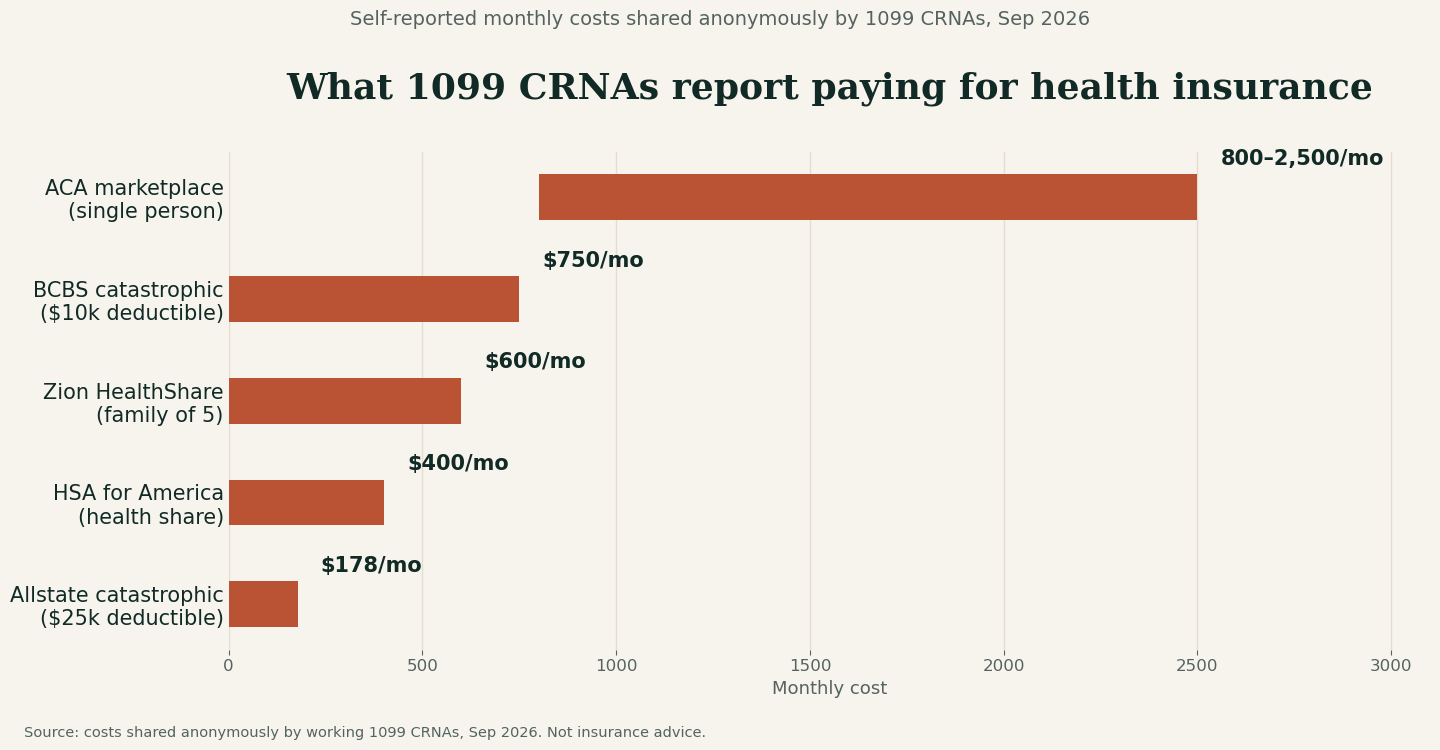
On the healthcare marketplace, a single individual can expect quotes of $800 to $2,500 a month. That is $9,600 to $30,000 a year in premiums alone, for one person. For a family of five on a marketplace plan, expect to pay closer to $2000 to $2500 a month which is approximately $24,000 to $30,000 in premiums alone.
Next year looks rough on both sides of the insurance market. On the ACA marketplace, insurers are proposing a median premium increase of 15% for 2027, according to KFF’s analysis of filings across all 50 states, the second straight year of double-digit hikes after a finalized 20% increase for 2026. Part of the pressure comes from the expiration of enhanced premium tax credits at the end of 2025, which hits middle-income buyers who don’t qualify for subsidies the hardest. W-2 workers aren’t spared either: a Marsh survey of 1,800 employers projects employer-sponsored plan costs rising 8.2% per employee in 2027, the largest jump since 2003, with 59% of employers planning cost-cutting changes like higher deductibles and about two-thirds of large employers expecting to raise the share workers pay out of their paychecks. So in summary, the prices are going up for everyone.
What can you do and what are your options?
So it is worth a careful look at the alternatives CRNAs are actually using. For each one, here is roughly what a single person and a family of five might pay per month, and the trade-offs as honestly as I can state them.
Paying cash for each appointment
This means carrying no insurance at all and paying for care visit by visit. A self-pay primary care visit runs about $130 to $200 according to 2026 national data, and urgent care visits typically cost $100 to $250 in cash. Federal law also gives uninsured patients the right to a Good Faith Estimate before scheduled care, so you can shop around.
For a healthy single adult with three or four routine visits in a year, that might total somewhere around $500 to $1,000 for the year, plus whatever labs or imaging cost separately. That illustration assumes a quiet year, which is the point and also the risk. For a family of five, the arithmetic gets busier: kids’ sick visits add up, and there’s always the month when two of them need care at once. A rough illustration would be $1,500 to $2,500 in a routine year, again before labs, imaging, or anything unexpected.
What works: complete price transparency, no monthly premium, no networks, and providers often discount for cash.
What to watch: there is no ceiling on a bad year. One emergency room visit or hospitalization can erase a decade of premium savings, and cash patients don’t get insurers’ negotiated rates on big-ticket care like labs and imaging.
This is why, if you are considering dumping your health insurance plan, most people merge cash payments with a catastrophic only plan as discussed below.
Catastrophic-only plans
These are plans with very low monthly costs and very high deductibles, designed to protect against disaster while you fund routine care yourself. From what CRNAs have shared with me: one person pays $178 a month ($2,136 a year) for a private catastrophic plan with a $25,000 deductible, and another pays $750 a month ($9,000 a year) for a Blue Cross catastrophic plan with a $10,000 deductible.
For a family of five, I don’t have a reliable figure from anyone I’ve talked to, and pricing varies widely by state and ages, so get a direct quote rather than trusting a rule of thumb. One thing worth knowing: catastrophic plans sold on the ACA marketplace are generally limited to people under 30 or those with hardship exemptions, so many CRNAs and their families can’t buy them on the exchange. The low-cost catastrophic plans CRNAs described to me were private, non-marketplace plans.
What works: the monthly cost is a fraction of a standard plan, and you’re covered if something truly catastrophic happens.
What to watch: the deductible means you pay for nearly all routine care out of pocket anyway.
Non-marketplace plans can exclude pre-existing conditions and don’t have to cover the essential benefits marketplace plans do. And these plans are usually not compatible with HSA contributions.
Health care sharing programs
In these programs, members pool money to share each other’s medical costs. They are not insurance companies. A family of five should expect to pay about $600 a month ($7,200 a year) while a single CRNA pays about $400 a month ($4,800 a year). Published ranges are broadly consistent: individual shares from roughly $87 to $362 a month and family shares starting around $250 to $319 a month depending on the program.
What works: the monthly cost is far below marketplace premiums and you generally choose your own providers. Enrollment is also open year-round rather than limited to open enrollment season. Some CRNAs pair a sharing program with an HSA-compatible setup.
What to watch: Sharing programs are not regulated as insurance, and nothing guarantees your bills will be paid. Programs can also decline to share certain costs or exclude pre-existing conditions. Some require faith statements or lifestyle agreements. Read the membership guidelines like a contract, because that is effectively what they are.
Association plans and a broker who knows CRNAs
Several CRNAs have pointed me toward the AANA’s member health plans, and others recommended working with an insurance broker experienced with CRNAs specifically. Pricing here varies too much by state, age, and family size to estimate responsibly. The value is different: someone who understands how 1099 income and HSA rules affect plan choice can run the quotes and the tax implications together, which is more than most of us will do on our own on healthcare.gov at 11pm.
Sitting with the decision
Open enrollment for 2027 runs November 1, 2026 through January 15, 2027 in most states, with December 15 as the cutoff for coverage starting January 1. That is the window to make a deliberate choice instead of letting your current plan auto-renew into a higher premium.
Whatever direction you lean, run the full-year math for your actual life: premiums times twelve, plus what you’d realistically spend on care in a normal year and in a bad one. The plan with the lowest monthly payment is not always the cheapest year, and the plan with the highest premium is not always the safest. The numbers above are a starting point. Your quote and your health fill in the rest.