1099 CRNA Expense Tracking, Done Weekly Instead of in a Panic Every April

The first time I sat down to pull a year of business expenses together, I was going through bank statements line by line trying to remember what each charge was. This post is the expense tracking system that replaced that — which expenses a 1099 CRNA should log, how to log them so they are still useful at tax time, and the weekly habit that keeps it small.
If your income side is not organized yet, start with the spreadsheet I use to track every dollar from my own practice. Expenses are the other half of that same file, and the two halves are what produce the profit number everything else depends on.
Which expenses should a 1099 CRNA expense tracker cover?
The categories that matter for us are not the ones in a generic business template. Mine are:
Licenses and certifications. APRN and RN license renewals, NBCRNA certification, and ACLS, BLS, and PALS courses. These are required to work at all, they renew on a cycle, and they are easy to forget because each one is paid in a different month.
Malpractice insurance. If your facilities cover you, this line may be small. If you pick up work at facilities that do not provide coverage and you buy your own policy, it is one of your largest single expenses and it belongs in the tracker the day you pay it.
Continuing education. Courses, conferences, and the travel that goes with required education. Small amounts, spread all over the year — exactly the kind of expense that disappears without a log.
Mileage. Driving between facilities is a real cost of this work. I log date, destination, and miles the day I drive. The yearly total surprises most people the first time they see it added up.
Professional services. Payroll processing, bookkeeping help, tax preparation, and business banking costs. Running yourself as a business has an overhead, and this is where it shows.
Health insurance premiums. For most 1099 CRNAs this is the biggest expense on the page. Mine runs through an association plan, and I wrote a full post on health coverage options for when health insurance costs are too high if you are still choosing yours.
Log an expense in one of these buckets the week it happens and tax time becomes a printout instead of an investigation.
Why does the category matter so much?
Because your tax return sorts expenses into categories whether you plan for it or not. If your tracker already uses the same buckets your return will, the year-end work is copying totals across. If your tracker is one long undifferentiated list, someone — you or a paid preparer — has to sort every line in April, and anything that cannot be identified tends to get dropped.
There is a second reason. Your profit is income minus expenses, and your quarterly tax payments are based on that profit. I set aside 20% of net profit for taxes as the year goes, the method I described in the spreadsheet post. Sloppy expense tracking means the profit number is wrong, which means the set-aside is wrong in one direction or the other.
Clean categories are not bookkeeping neatness for its own sake. They are what make every number downstream of them trustworthy.
What does the weekly habit actually look like?
Ten minutes, once a week. I open the tracker, enter the week’s expenses while I still remember what they were, and take a photo of any paper receipt before it fades or gets lost. Mileage goes in the same sitting. That is the entire system.
Monthly, I scan the totals against my business bank account to catch anything I missed. Quarterly, the expense totals feed straight into the profit figure I use for my estimated tax payment, which you can estimate for your own situation with the free quarterly tax calculator.
The point worth keeping is that expense tracking fails as a yearly project and works as a weekly one. Every system that depends on remembering a year of purchases will quietly lose you money.
The tracker I use
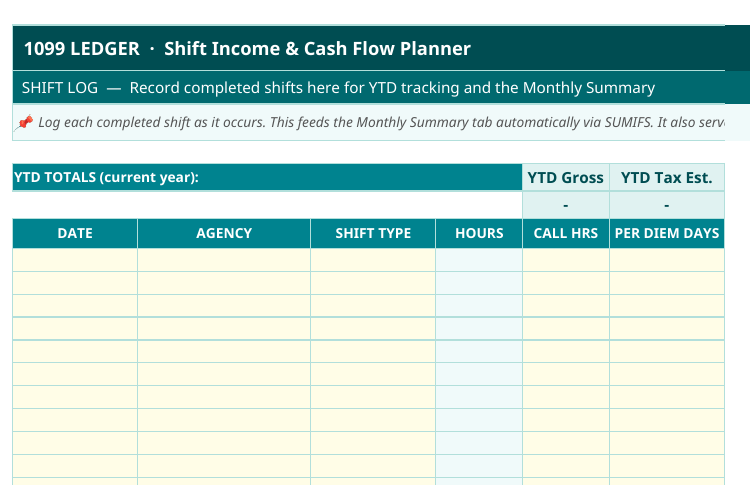
My expense tracking lives in the same file as my income tracking, The 1099 Ledger, because profit only exists where the two meet. The expense side is set up with the CRNA categories above, the mileage log is built in, and the summary page rolls everything into the net profit figure I base my quarterly set-aside on. It is $68.99, one time, and it is the file I use for my own books.
You can build the same structure yourself from the categories in this post — the categories are the valuable part. What you cannot do is reconstruct a year of expenses accurately in April, no matter what tool you buy then. Start the log this week and let it be boring.
Questions CRNAs ask about expense tracking
Can I deduct my health insurance premiums as a 1099 CRNA? Premiums are one of the largest expenses most of us carry, and they belong in your tracker from the first payment. How they are treated on your return depends on your business structure, which is a question worth one conversation with your tax preparer — but you cannot claim or plan around an expense you never logged.
How long should I keep receipts? Photograph them the week you spend the money and keep the digital copies with the year’s records. Paper fades, gets lost, and cannot be searched.
Is mileage really worth logging for short drives? Yes. Short drives between facilities, repeated all year, add up to a number that matters. Log them the day you drive and let the tracker do the adding.